Navigating the Post-Pandemic Surge: Transforming Utility Credit & Collections
How a regional utility tackled a 200% increase in aged receivables through strategic automation and organizational redesign.
Article Overview
General Overview
The COVID-19 pandemic created unprecedented challenges across the utility sector. As economic pressures mounted and payment assistance programs evolved, many utility providers found themselves facing a collections crisis unlike anything in recent memory. This is the story of how one regional utility transformed operational/economic disruption into a strategic advantage through data-driven consulting and phased implementation.
Industry Context: A Universal Challenge
This transformation did not occur in a vacuum. The post-pandemic landscape has fundamentally reshaped utility collections across North America. We reviewed these broader trends to understand why this work was urgent and strategically important.
National Utility Debt Trends
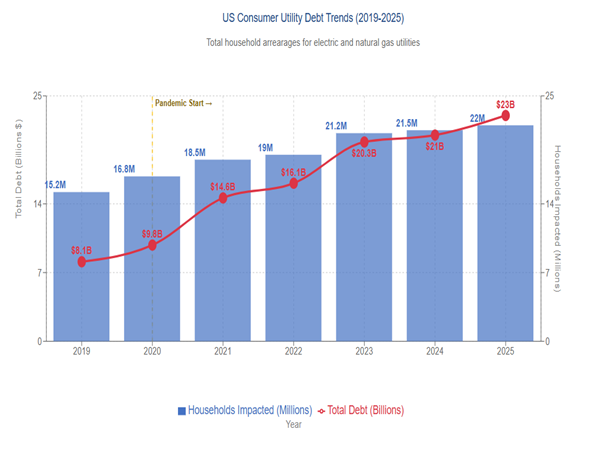
National Energy Assistance Directors Association (NEADA) / NEADA Energy Hardship Report, August 2024 Direct link: https://neada.org/energy-affordability-project/
By the Numbers
• 1 in 6 households in the U.S. is behind on utility bills.
• 1 in 5 households is unable to pay utility bills in full at least once in the past year.
• 31% increase to $23.0 billion since December 2023.
• Record household debt levels reported in 2024.
• Rising delinquency rates across all consumer credit categories.
According to recent data, approximately one in six households in the U.S. is behind on utility bills, with national arrearage balances increasing by 31%% to $23 billion. This is not just one utility's problem; it is an industry-wide transformation imperative.
The Challenge for the East Coast Utility: A Perfect Storm
When the pandemic hit, an East Coast utility, serving hundreds of thousands of customers, experienced what many in the industry faced: a dramatic surge in accounts receivable that overwhelmed existing operational capacity.
The Magnitude of the Challenge
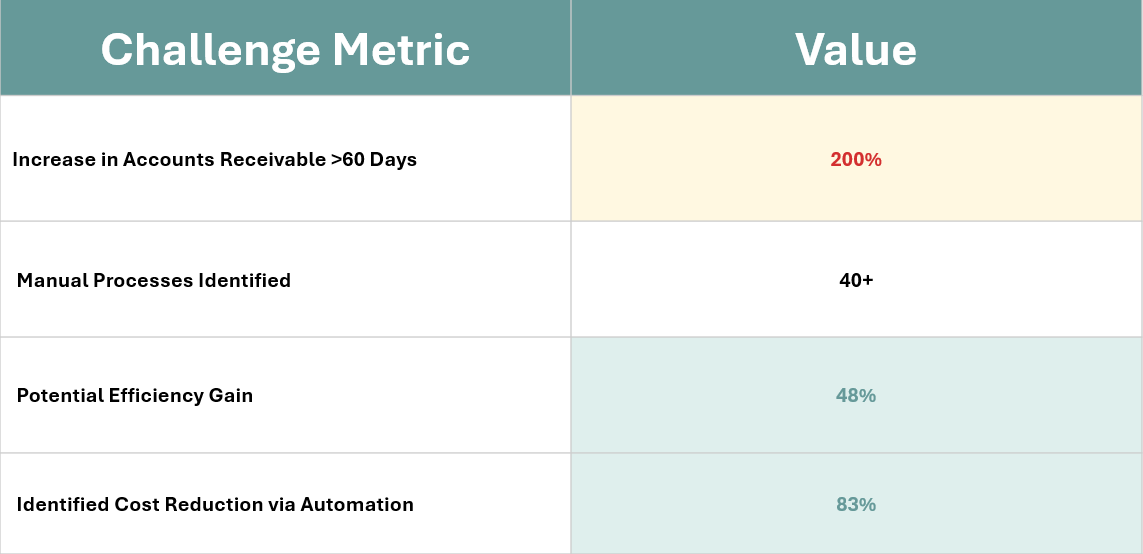
The operational crisis manifested across multiple dimensions, each metric revealing a different facet of systemic breakdown. The 200% increase in aged receivables beyond 60 days signaled not just delayed payments but a fundamental operational disconnect between collections capacity and customer payment behavior. Through a comprehensive assessment, the consulting team identified 40+ manual processes that created bottlenecks, consumed valuable staff time, and prevented scalable operations. However, the diagnostic also revealed significant transformation potential; 48%+ efficiency gains were achievable through targeted automation. These metrics revealed both urgency and opportunity.
Methodology: A Structured Approach
The transformation required a rigorous, evidence-based methodology combining quantitative analysis with qualitative insights. Our approach integrated stakeholder engagement, data analytics, operational observation, and strategic planning to build a comprehensive transformation roadmap.

Five-Phase Engagement Model
This methodology balanced the need for comprehensive analysis with the imperative for rapid, visible progress.
Phase 1: Discovery & Kickoff
Duration: 2 Weeks | Stakeholder Engagement: 15+ Leaders | Deliverable: Project Charter & Workplan
The engagement commenced with executive alignment sessions designed to establish a shared understanding of project objectives, success criteria, and organizational commitment. Through structured stakeholder interviews across all levels of leadership, the Voyage Advisory consulting team gathered critical context on operational challenges, strategic priorities, and cultural dynamics. A comprehensive data request was compiled to ensure access to the full spectrum of operational, financial, and performance information necessary for rigorous analysis. The project governance structure, including steering committee composition, decision rights, communication protocols, and escalation procedures, was formalized to ensure effective coordination throughout the engagement. This foundational phase culminated in the Project Charter and Workplan, establishing clear scope, timelines, and mutual commitments between the consulting team and client organization.
Phase 2: Current State Analysis
Duration: 4 Weeks | Analysis Scope: 120+ Reports | Observation: 90+ Hours | Deliverable: Current State Process Maps
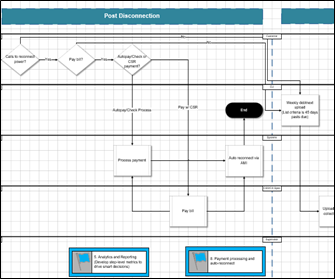
This diagnostic phase involved intensive process mapping workshops where subject matter experts walked through end-to-end workflows, decision points, and system interactions. The consulting team conducted time studies to establish baseline performance metrics and identify productivity constraints. More than 120 reports, procedures, and operational logs were analyzed to understand volume patterns, error rates, and system capabilities. Through 90+ hours of side-by-side observation, consultants documented actual work practices, measured task durations, and identified disconnects between formal procedures and daily reality. A Technology assessment examined the capabilities and limitations of core systems, evaluating integration points, data quality, and automation opportunities. This comprehensive analysis produced detailed Current State Process Maps that became the foundation for identifying improvement opportunities and quantifying the transformation potential.
Phase 3: Opportunity Identification
Duration: Started Day 1 | Opportunities Identified: 60+ | Processes Assessed: 40+ | Deliverable: Opportunity Register & Prioritization Matrix
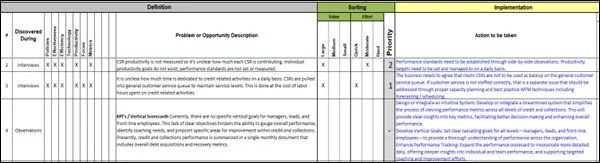
Building on the current state analysis, this phase systematically identified and evaluated improvement opportunities across all operational dimensions. The team developed an automation classification matrix, categorizing each of the 40+ mapped processes by automation feasibility, development effort, and expected impact. Impact and effort assessments were conducted for each opportunity, considering not only quantitative benefits but also implementation complexity, organizational readiness, and strategic alignment. Industry benchmarking provided an external perspective on performance gaps and best practices, helping distinguish between industry-standard capabilities and true competitive differentiators. Rigorous cost-benefit analysis quantified the financial case for each major initiative, establishing clear ROI expectations. Quick improvement deliverables that could be implemented within 30-90 days were specifically identified to build momentum and demonstrate tangible value. The phase produced a comprehensive Opportunity Register with Prioritization Matrix, organizing 60+ opportunities by strategic importance and implementation sequencing.
Phase 4: Future State Design
Duration: 5 Weeks | Strategic Workstreams: 7 | Planning Horizon: 5 Years | Deliverable: Target Operating Model
This critical phase translated opportunity insights into actionable design specifications. Future state process design reimagined how work would flow in a transformed environment, incorporating automation, enhanced decision support, and improved customer touchpoints. Technology requirements were precisely defined for each capability enhancement, specifying functional needs, integration points, data requirements, and success metrics. Organizational redesign addressed structure, roles, and skill requirements, ensuring the organization could effectively operate the future state. The team developed capacity modeling scenarios to quantify staffing implications under different volume and automation assumptions, enabling informed resource planning. A comprehensive management strategy was crafted to address the human dimension of transformation, communication plans, training requirements, stakeholder engagement approaches, and resistance mitigation strategies. These elements were synthesized into seven strategic workstreams, each with clear objectives, dependencies, and success criteria. The Target Operating Model deliverable provided a comprehensive blueprint for the transformed organization, spanning people, process, technology, and governance dimensions.
Phase 5: Roadmap & Execution
Duration: 2 Weeks | Quick Wins Deployed: 8 | IVR Expansion: 300→500 Daily Calls | Deliverable: Strategic Roadmap & Implementation Plan
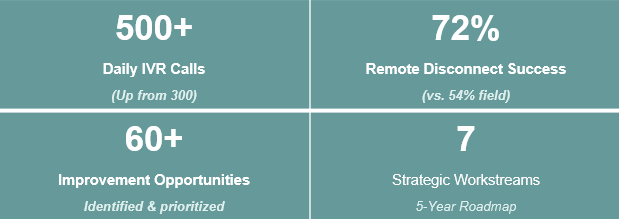
The final phase translated strategic vision into tactical execution plans. We broke each workstream into projects with scope, resources, timelines, and success metrics. Each workstream was decomposed into specific projects with defined project charters, which included: scope, resources, timelines, and success metrics. KPI dashboards were deployed to provide real-time visibility into operational performance, enabling data-driven management and course correction. The IVR expansion, from 300 to 500 daily calls, represented the first major quick win, demonstrating immediate revenue impact and building credibility for broader transformation efforts. A governance framework established ongoing oversight mechanisms, including steering committee cadence, progress reporting protocols, issue escalation procedures, and decision-making authorities. Success metrics and tracking mechanisms were implemented to ensure the transformation remained on course and delivered promised benefits. The Strategic Roadmap and Business Case provided leadership with a clear, actionable plan for the five-year transformation journey, complete with investment requirements, benefit projections, risk mitigation strategies, and key decision points.

ENGAGEMENT PHILOSOPHY
This methodology emphasizes collaborative partnership over prescriptive consulting. By embedding consultants alongside frontline staff for 90+ hours of observation and involving stakeholders in co-creation workshops, we ensured solutions were grounded in operational reality while leveraging industry best practices. The result: a transformation roadmap with genuine buy-in and executable precision.
Key Findings Example: What the Data Revealed
COST IMPACT ANALYSIS
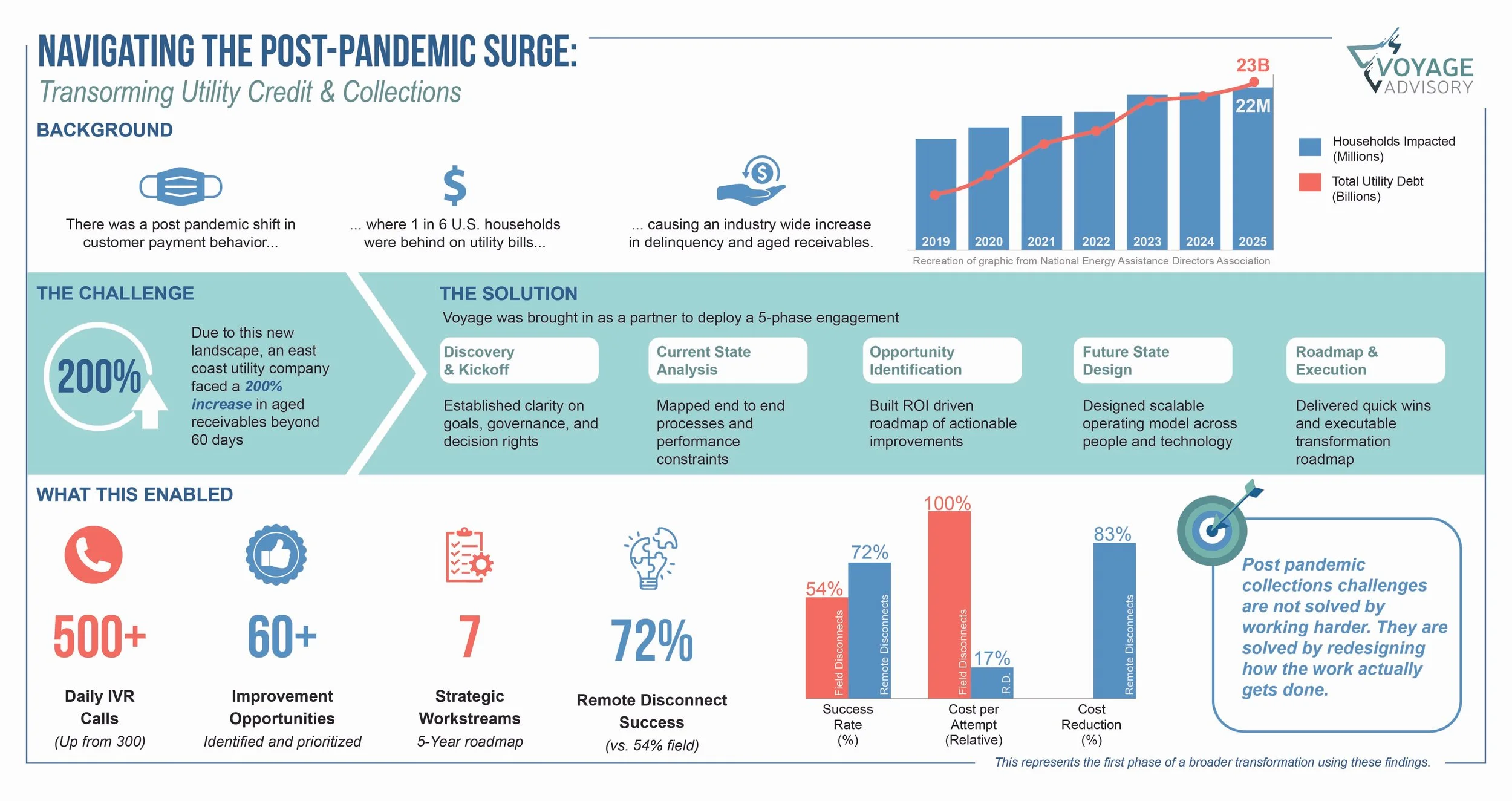
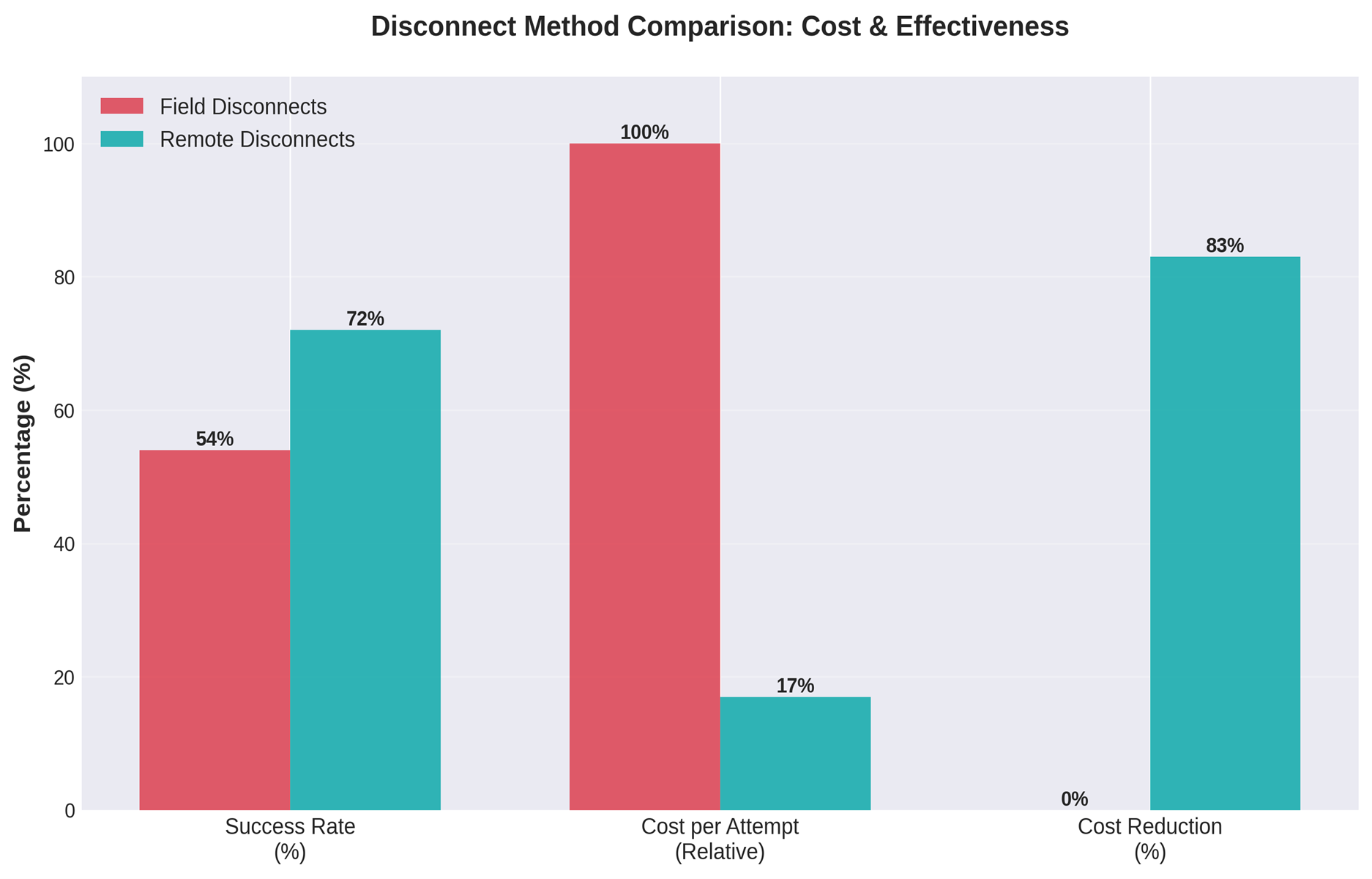
Field disconnects required truck rolls and on-site visits at an average cost of $45 to $60 per attempt, while remote AMI disconnects eliminated travel costs to lower the average cost down to just $8 to $10 per attempt, representing an 83% cost reduction. Beyond the direct savings, remote disconnects achieved higher success rates at 72% compared to 54% for field visits and completed the process in minutes instead of days. This operational shift becomes even more powerful when paired with strategic communication throughout the customer journey.
Automated outbound messaging at critical moments, sending notifications before a disconnect, providing status updates during the process, and confirming reconnection, transforms a traditional manual operation into a streamlined customer experience. The result is a system that not only reduces costs dramatically but also reduces customer complaints, decreases call center volume, and enables faster service restoration. What once required multiple trucks on-site support, delayed timelines, and frustrated customers can now happen seamlessly through integrated automation and proactive communication. This combination of remote technology and targeted customer touchpoints delivers efficiency gains that manual processes simply cannot match.
The Solution: A Comprehensive Roadmap
The transformation strategy centered on a comprehensive, well-defined 5-year roadmap addressing seven interconnected workstreams. Each workstream was carefully sequenced to build upon previous accomplishments while delivering incremental value.
Results & Impact
The results identified below were driven by preliminary organizational changes, tactical adjustments to processes, workflows, and operational approaches implemented during the engagement. These early wins demonstrate the immediate value of strategic intervention and organizational commitment to transformation.
However, it is critical to note that these results represent only the beginning of the transformation journey. With the comprehensive technology implementation, formalized processes, and organizational redesign outlined in the strategic roadmap and future state design, performance optimization will be significantly amplified. The full realization of automation capabilities, advanced analytics, and integrated systems will deliver exponentially greater operational efficiency, cost reduction, and customer experience improvements than these preliminary achievements suggest.
The Path Forward
As the utility implements automation and connects systems, the improvements will build on each other and position the organization to compete as the industry evolves. Takeaways for Utility Leaders.
Based on this comprehensive transformation engagement, five strategic imperatives emerged as critical success factors for utilities facing similar post-pandemic challenges.
Strategic Imperatives For Utility Leaders
5 Non-Negotiable Success Factors for Post-Pandemic Transformation
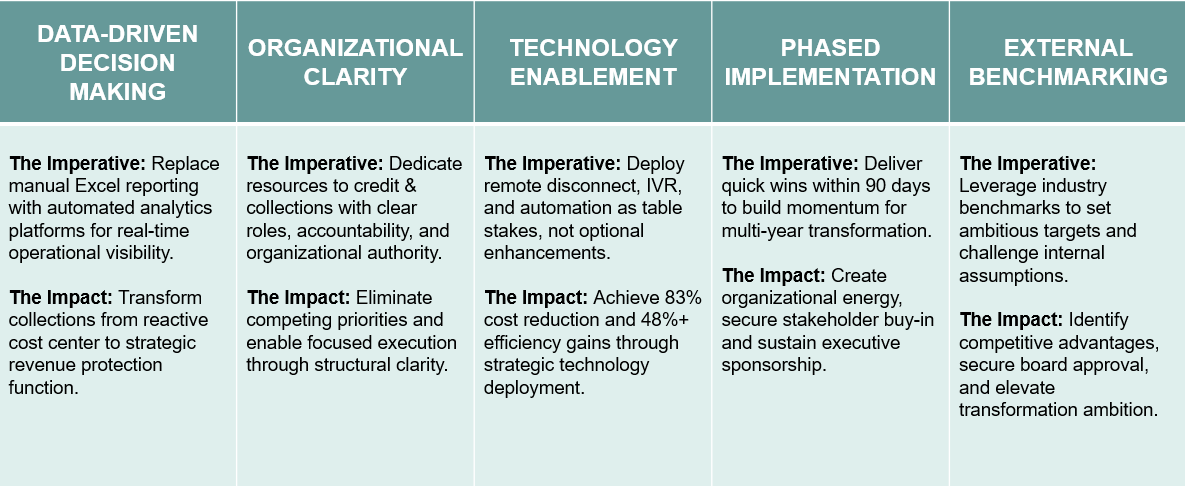
These imperatives are interconnected; success requires commitment across all five dimensions.
Conclusion: From Crisis to Capability
The post-pandemic surge in aged receivables could have been just another operational crisis to manage. Instead, this utility transformed it into a catalyst for comprehensive operational excellence. With Voyage Advisory working with the team, combining strategic (in the trenches) consulting, data-driven analysis, and phased implementation, they built not just a solution to today's challenges but a foundation for tomorrow's competitive advantage.
The journey from 40+ manual processes to an automated, data-driven operation demonstrates what's possible when organizations commit to transformation. The methodology, rigorous assessment, collaborative design, and evidence-based prioritization proved as important as the specific recommendations themselves.
For utilities facing similar challenges, the path forward is clear: assess comprehensively, plan strategically, implement progressively, and measure relentlessly. The tools, technologies, and best practices exist. What is required is organizational commitment and the willingness to challenge long-standing operational norms.
The transformation imperative is clear; the question is whether you will lead or follow.
Written by: Roger LaGrone