
Intelligent strategy for transformation and automation
Date Published
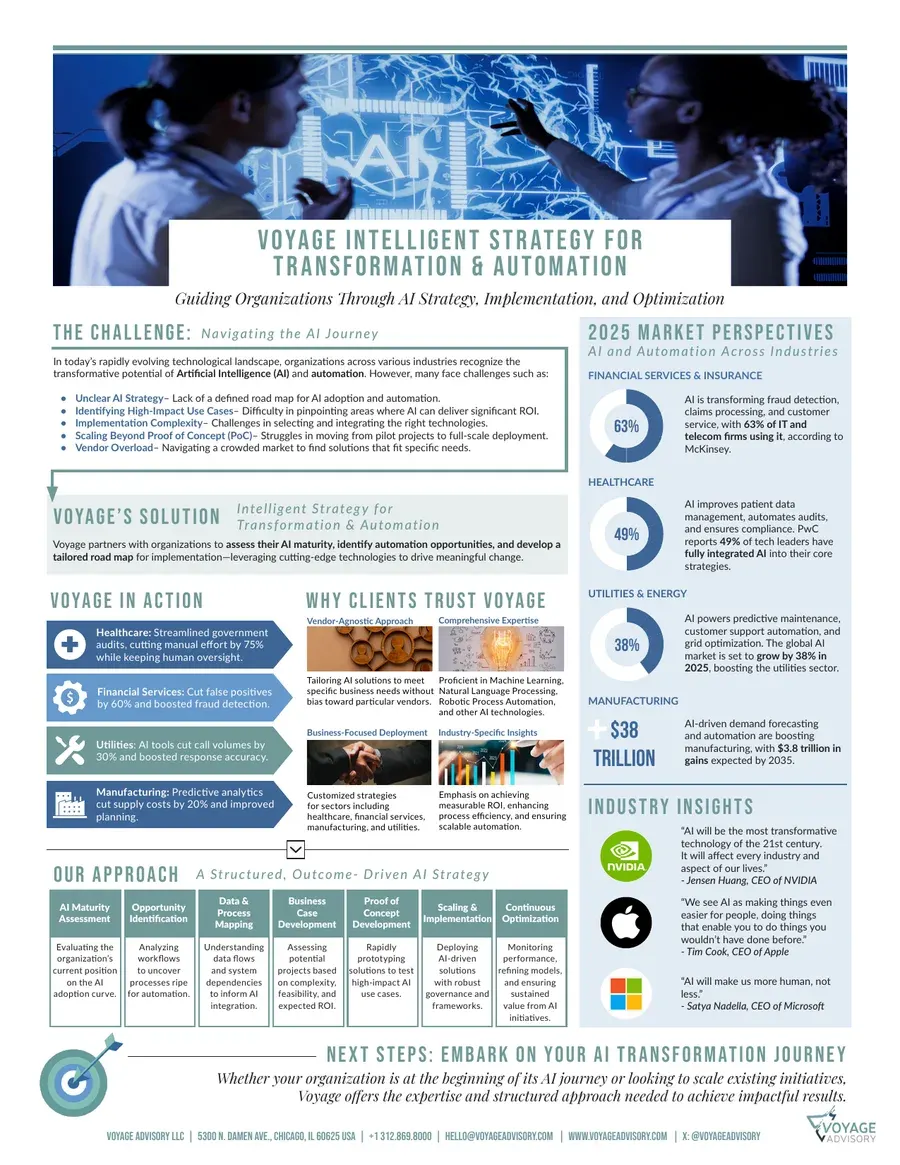
Organizations recognize what AI and automation could do and then stall in one of five places: no clear strategy, no way to tell which use cases will actually pay, difficulty selecting and integrating the technology, an inability to get past proof of concept, and a vendor market crowded enough to make evaluation its own project.
The path
AI maturity assessment. Establish where the organization actually sits on the adoption curve, rather than where it would like to be.
Opportunity identification. Analyze workflows to find the processes genuinely ripe for automation.
Data and process mapping. Understand data flows and system dependencies, because these are what integration runs into.
Business case development. Assess candidate projects on complexity, feasibility and expected return, and rank them.
Proof of concept. Prototype quickly against the high-impact cases, so the evidence arrives before the commitment does.
Scaling and implementation. Deploy with governance around it.
Continuous optimization. Monitor performance, refine models, and keep the value from decaying.
What it has produced
Healthcare. Government audits streamlined, cutting manual effort by 75 percent while keeping human oversight in place.
Financial services. False positives cut by 60 percent, with fraud detection improved rather than traded away.
Utilities. AI tools cut call volumes by 30 percent and improved response accuracy.
Manufacturing. Predictive analytics cut supply costs by 20 percent and improved planning.
Why vendor-agnostic matters here
Voyage tailors the solution to the requirement without a preference for a particular vendor, and works across machine learning, natural language processing and robotic process automation rather than a single stack. On a decision this expensive, an adviser with a product to sell is a different adviser.