

Built for a Smaller Era: Why Utility Capital Programs Are About to Be Tested Like Never Before
Author
Andrew C. Studee
Date Published

The scale of utility capital programs is set to nearly double over the next five years. Most delivery organizations were designed for the portfolio they had a decade ago – and the gap between the two is where the next wave of overruns, delays, and disallowances will come from.
Utilities have entered the most capital-intensive period in their history. Load growth is back after two decades of flat demand, driven by data centers, electrification, and industrial reshoring. Grid hardening and wildfire mitigation programs are expanding. Aging infrastructure built in the postwar boom is reaching end of life all at once. Any one of these would strain a capital program. Utilities are facing all of them simultaneously.
The doubling
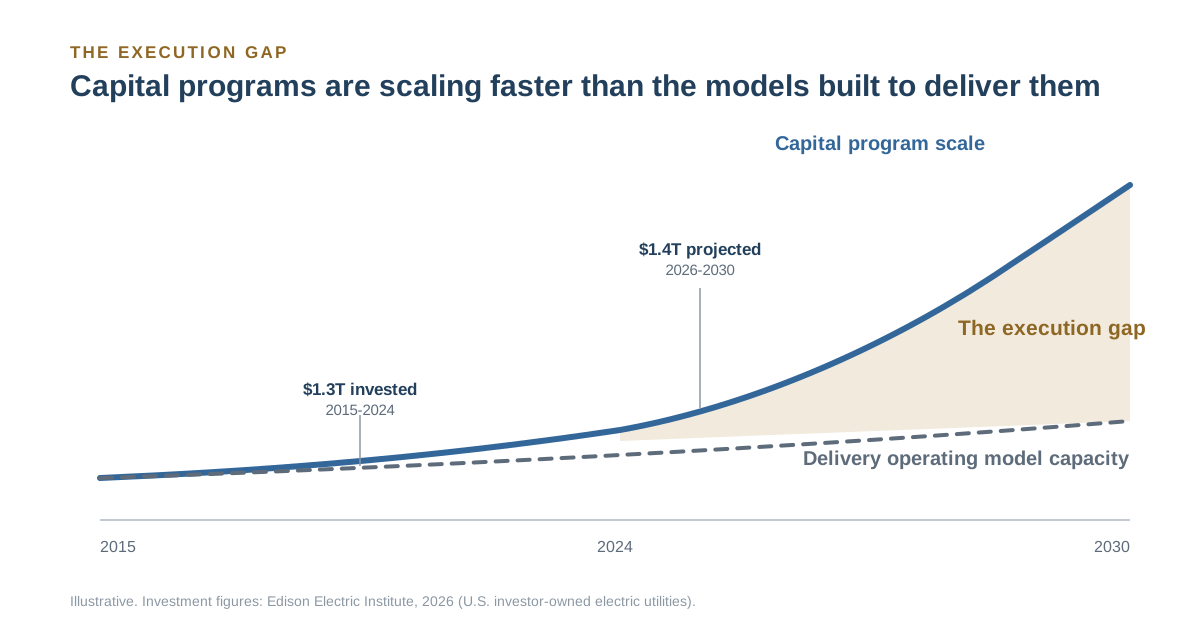
The numbers are no longer projections buried in planning documents – they are in this year’s budgets. Investor-owned electric utilities in the United States are expected to invest $1.4 trillion between 2026 and 2030, after spending $1.3 trillion over the entire prior decade. Annual capital expenditures, which set a record of $204 billion in 2025, are projected to jump 17 percent in 2026 alone.1 For many individual utilities, that trajectory means a capital program roughly twice the size of the one they ran just a few years ago.
It is tempting to read that as a bigger version of business as usual – the same work, more of it. It isn’t.
Doubling a capital program doesn’t just mean more projects. It means more contractors competing for the same constrained labor pool. More long-lead equipment orders in queues that already stretch years. More regulatory filings, more community engagement, more interdependencies between projects that used to be planned independently. Complexity doesn’t scale linearly with dollars – it compounds. A program twice the size is considerably more than twice as hard to deliver.
The cost of getting it wrong
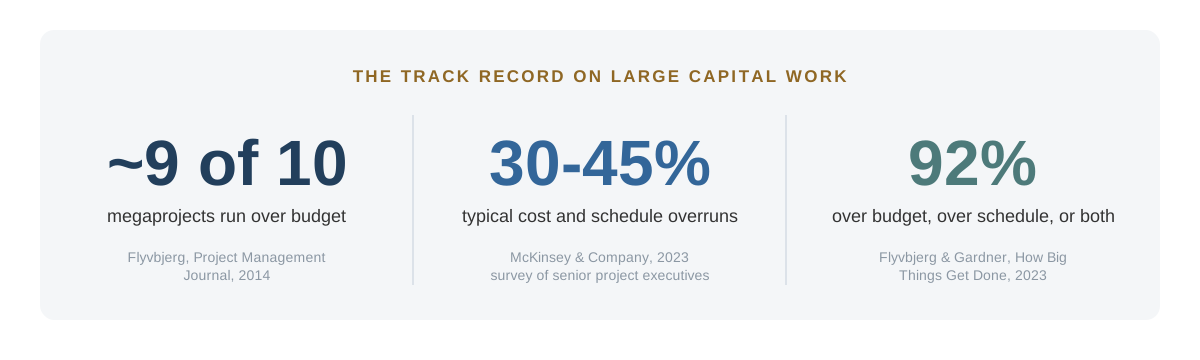
The track record on large capital work should give every executive pause. Roughly nine of ten megaprojects run over budget.2 When overruns happen, they aren’t small – senior project executives report that cost and schedule overruns of 30 to 45 percent are typical.3 And in the most comprehensive study of megaprojects ever assembled, 92 percent came in over budget, over schedule, or both.4
For utilities, the consequences land in three places, and none of them heal on their own:
- Delays forfeit revenue you never get back. A transmission line that enters service a year late doesn’t earn that year’s revenue later – it’s simply gone. In an era when capital additions are the primary driver of earnings growth, schedule slip is an earnings problem, not just a project problem.
- Overruns invite regulatory scrutiny. Every dollar over the approved estimate has to be defended in a rate proceeding. Prudence reviews are getting sharper as capital plans get larger, and disallowed costs are absorbed by shareholders, not customers.
- Customers remember. Rate cases built on capital programs that visibly underperformed erode the trust that every future filing depends on. The reputational cost of a troubled program outlasts the program itself.
Most capital programs aren’t poorly managed
Here is the part that gets missed in most conversations about capital performance: the problem usually isn’t the people.
Most utility capital delivery organizations are staffed by capable, experienced professionals doing exactly what their operating model asks of them. The issue is that the operating model itself was built years ago – often decades ago – for a portfolio that was smaller, simpler, and slower-moving. Prioritization processes designed to rank forty projects are now ranking four hundred. Estimating approaches calibrated to a stable cost environment are being asked to price work in a volatile one. Contractor management practices built around a handful of trusted vendors are now coordinating dozens. Reporting that lived comfortably in spreadsheets can no longer keep pace with the portfolio it describes.
None of this represents failure. It represents an organization that succeeded at the scale it was designed for – and is now being asked to operate at a scale it was never designed to reach.
Where the strain shows first
In our work with utilities, the early symptoms of an operating model under strain are remarkably consistent:
- Prioritization by urgency rather than value. The backlog is shaped by whoever escalates loudest, because the formal process can’t keep up with intake volume.
- Estimates that erode confidence. Actuals drift from estimates in one direction, and the organization compensates with contingency instead of fixing the estimating engine.
- Contractor relationships managed transactionally. Procurement treats every engagement as a one-off, and no one owns contractor performance across the portfolio.
- Data everyone has and no one trusts. Program status lives in a dozen spreadsheets that disagree with each other, so leadership meetings are spent reconciling numbers instead of making decisions.
If two or more of these sound familiar, the model – not the team – is the constraint.
What to do about it
The good news: capital delivery operating models can be modernized deliberately, and the work pays for itself quickly. Three principles matter most.
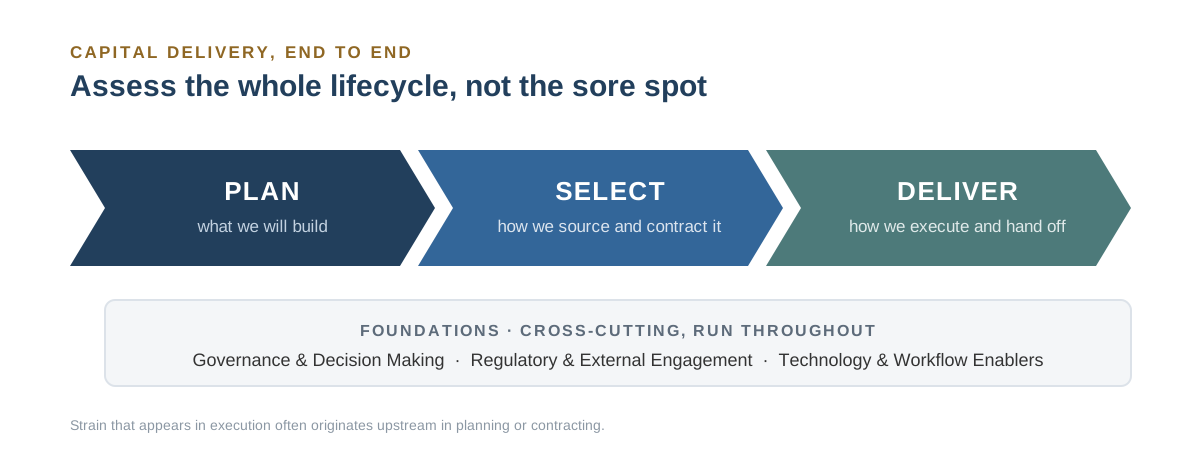
Assess the whole lifecycle, not the sore spot. Capital delivery spans planning (what we will build), acquisition (how we source and contract it), and execution (how we deliver and transition it to operations) – supported by cross-cutting foundations in governance, regulatory engagement, and technology. Strain that appears in execution often originates upstream in planning or contracting. A credible diagnosis stress-tests the full chain before prescribing anything.
Redesign, don’t patch. Adding staff, layering on new reports, or bolting a tool onto a strained process buys months, not years. The durable move is to redesign the operating model – decision rights, roles, workflows, governance – for the portfolio you will have, not the one you had.
Sequence the change as a portfolio. Transformation fails when it arrives as one monolithic program. It succeeds as a sequence of focused efforts, each with a clear owner, a measurable outcome, and a defined finish line – so the organization builds capability and confidence in parallel.
The math is forgiving
Modernizing capital delivery doesn’t require heroic improvement to justify itself. On a $1 billion annual capital portfolio, recovering even a percentage point or two of performance – schedule slip avoided, overruns reduced, disallowance exposure lowered – protects tens of millions of dollars every year. Against that arithmetic, the cost of deliberately modernizing the delivery engine is modest. The cost of not modernizing it compounds annually as the portfolio grows.
The window is now
The capital wave is not a forecast anymore – it is in this year’s filings, this year’s contractor negotiations, this year’s supply chain queues. The utilities that navigate the next five years well will be the ones that modernized their capital delivery engine before the wave crested, not during it.
If you’re seeing early signs of strain in your own program – or simply want an outside read on whether your operating model is built for what’s coming – we’d welcome the conversation.
Voyage Advisory helps utilities modernize capital program delivery through rapid assessment, operating model design, and hands-on implementation. Learn more at voyageadvisory.com.
Notes
- Edison Electric Institute, “EEI Data: Electric Companies to Invest $1.4T to Support Customers, Power Growth,” May 2026, https://www.electricperspectives.com/capital-expenditures-grid-investment/; Edison Electric Institute, 2024 Financial Review (Washington, DC: Edison Electric Institute, 2025).
- Bent Flyvbjerg, “What You Should Know About Megaprojects and Why: An Overview,” Project Management Journal 45, no. 2 (2014): 6-19.
- Daniel Ahmoye et al., “Increasing Transparency in Megaproject Execution,” McKinsey & Company, August 2023, https://www.mckinsey.com/capabilities/operations/our-insights/increasing-transparency-in-megaproject-execution.
- Bent Flyvbjerg and Dan Gardner, How Big Things Get Done: The Surprising Factors That Determine the Fate of Every Project, from Home Renovations to Space Exploration and Everything In Between (New York: Currency, 2023).