

Customer experience innovation: AI, automation and human-centered design
Date Published
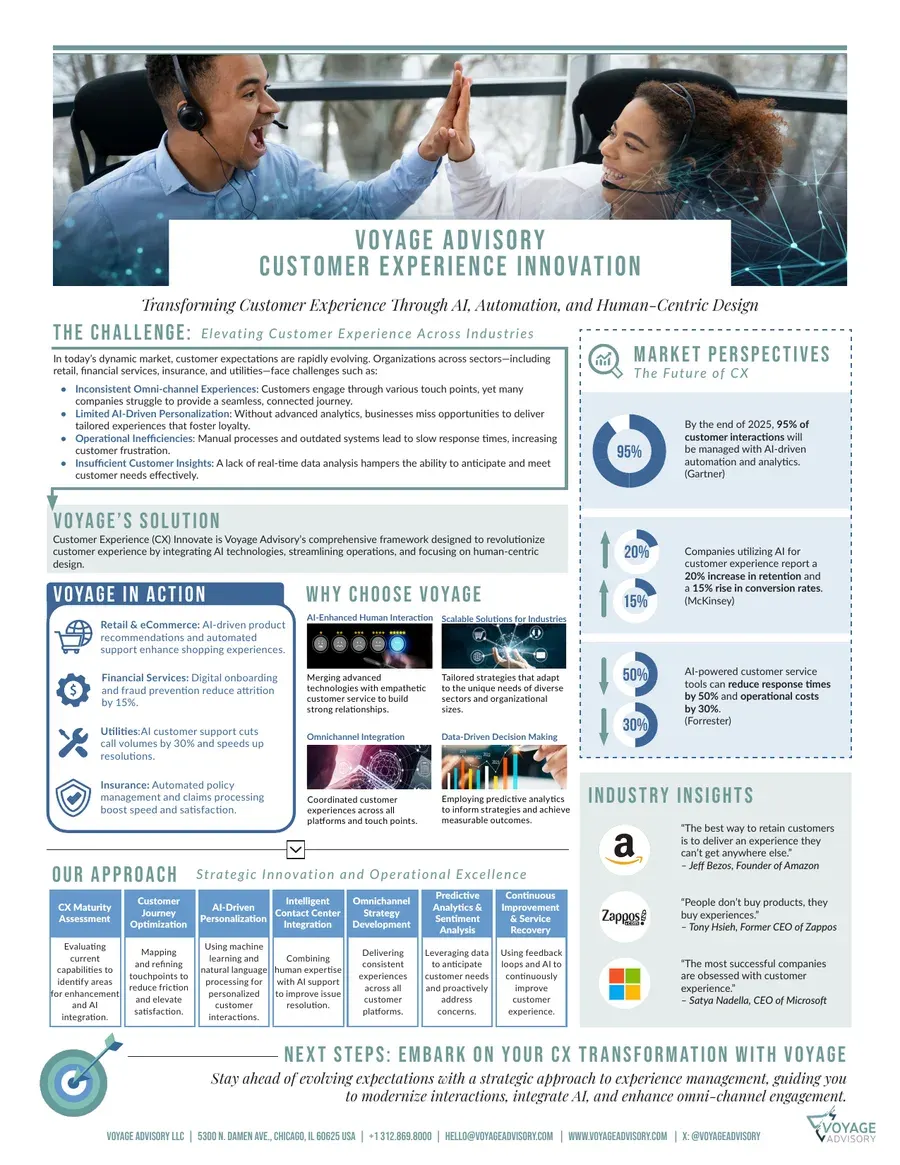
Customer expectations move faster than the operations built to meet them. The same four problems turn up across retail, financial services, insurance and utilities, and none of them is solved by buying a channel.
What is actually going wrong
Inconsistent omnichannel experience. Customers arrive through many touchpoints and few organizations can hand a conversation between them without losing what was already said.
Limited personalization. Without analytics underneath, tailoring is a segment rather than a person, and the loyalty it was supposed to build does not arrive.
Operational inefficiency. Manual steps and aging systems slow responses, and the customer experiences the delay as indifference.
Thin insight. Where there is no real time analysis there is no anticipation, so the operation is always answering rather than preparing.
The approach, in seven steps
CX maturity assessment. Establish what the organization can actually do today, and where AI would land on solid ground rather than on a gap.
Customer journey optimization. Map the touchpoints, find the friction, and remove it before automating anything.
AI-driven personalization. Machine learning and natural language processing applied to interactions that are worth personalizing.
Intelligent contact center integration. Human expertise with AI support, so resolution improves without the customer being handed to a wall.
Omnichannel strategy. One experience across platforms rather than several that agree by coincidence.
Predictive analytics and sentiment analysis. Anticipate need and surface concerns before they become complaints.
Continuous improvement and service recovery. Feedback loops that change the operation, and a recovery path for when it still goes wrong.
Where it has applied
Retail and ecommerce, through recommendation and automated support. Financial services, through digital onboarding and fraud prevention, cutting attrition by 15 percent. Utilities, where AI customer support cut call volumes by 30 percent and shortened resolution. Insurance, through automated policy management and claims processing.
What the market was projecting when this was written
This overview dates from February 2025 and the figures it cites are worth reading with that date attached. Gartner projected that by the end of 2025, 95 percent of customer interactions would be managed with AI-driven automation and analytics. McKinsey reported a 20 percent lift in retention and a 15 percent lift in conversion among companies using AI for customer experience. Forrester put the reduction in response times at 50 percent and operational cost at 30 percent.