

Selling Shovels: What $11.5 Billion Says About Where AI Value Really Comes From
Author
Andrew C. Studee
Date Published

When the people promising the gold start selling shovels, that should make you nervous. Last week, the two most formidable AI companies in the world did exactly that.
Within a span of hours on May 4, Anthropic and OpenAI each announced a services venture. Anthropic – the company behind Claude – is launching a roughly $1.5 billion enterprise AI services firm with Blackstone, Hellman & Friedman, and Goldman Sachs, with Anthropic, Blackstone, and H&F each committing about $300 million.1 Hours earlier, word broke that OpenAI – the company behind ChatGPT – was raising $4 billion from nineteen investors, including TPG and Bain Capital, for a venture called The Deployment Company, valued at $10 billion.2
Both ventures are aimed at the same problem: getting AI to actually work inside real businesses. The new firms will embed engineers directly inside companies, redesign workflows, and handle the advisory and implementation work needed to make adoption stick.
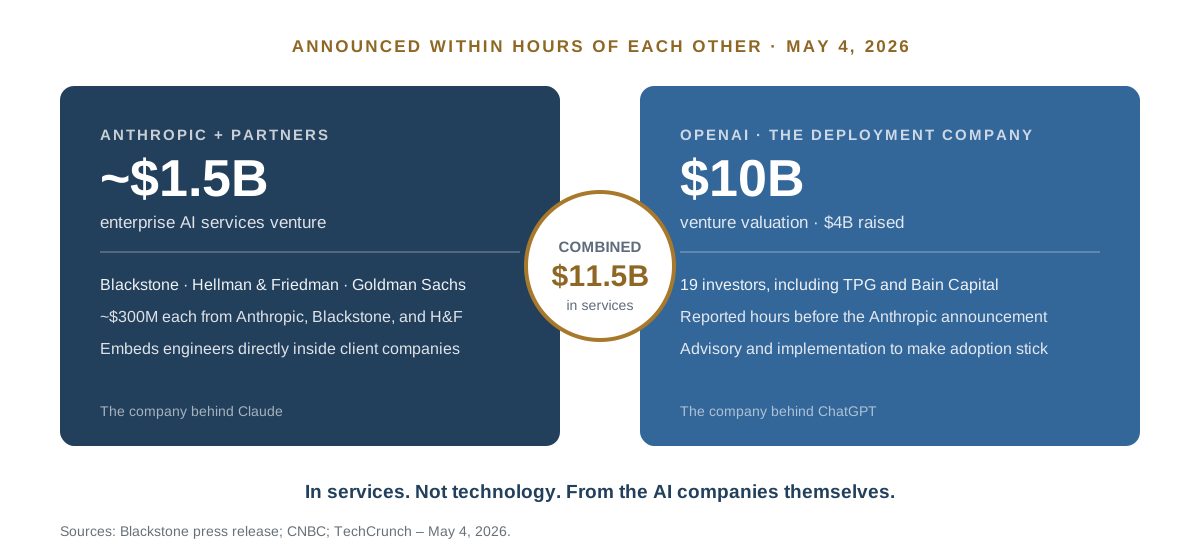
Read that again. Two ventures worth a combined $11.5 billion. In services. Not technology. From the AI companies themselves.
We have been here before
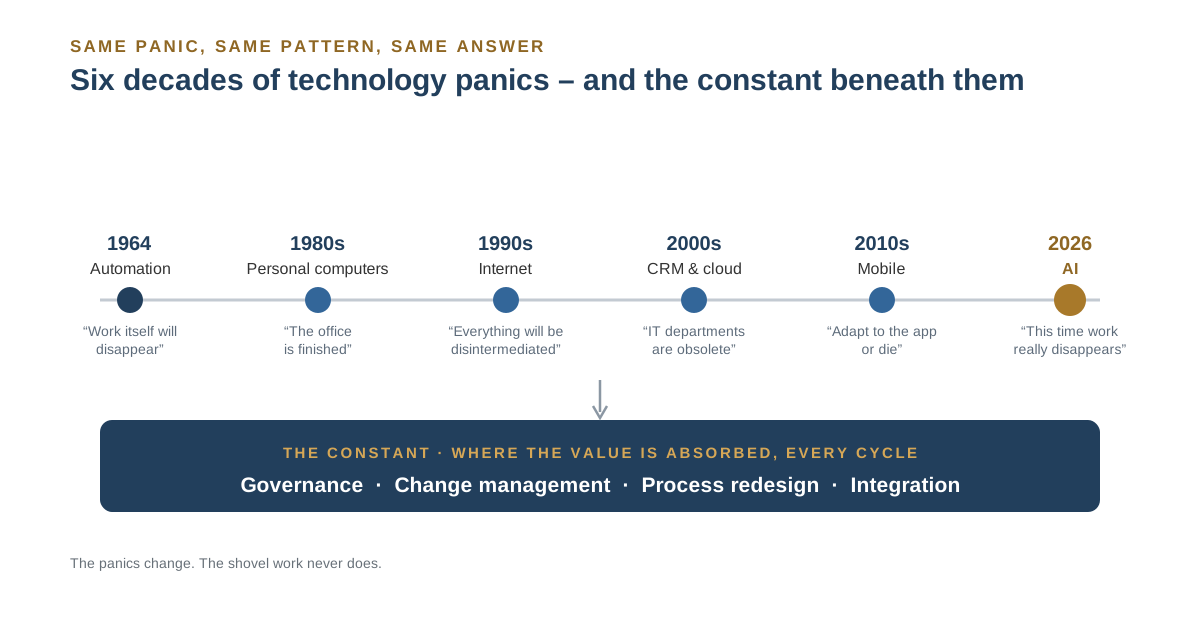
In May 1964, President Lyndon Johnson stood in front of the graduating class at the University of Michigan and described a future where automation would transform American work so thoroughly that leisure itself could become “a feared cause of boredom and restlessness.” The technology he was worried about was automation. The fear was a generation with nothing left to do. Three months later, he signed the law creating a federal commission to study whether work itself was about to disappear.3
President Johnson was wrong. The work didn’t disappear. It changed. And an entire services industry got built helping organizations absorb that change.
The same story has repeated every technology cycle since. Personal computers were going to eliminate the office. Instead, they created decades of work reorganizing it. The internet was going to disintermediate everything. Instead, it spawned an integration industry. CRM, cloud, mobile – same panic, same pattern, same answer. The technology was never the hard part for long. The hard part was governance. Change management. Process redesign. Integration with everything the company already runs on.
The shovels.
Follow the money
The AI labs have now told you, with their own capital, where they believe the bottleneck is. It is not model quality. While models are extraordinary, they are getting cheaper by the quarter – hundreds of them now, converging in capability, heading the way of every foundational technology before them: toward commodity.
The bottleneck is deployment. It always was. One widely cited figure puts the ratio at six dollars of services for every dollar of enterprise software spend – a ratio that built the modern consulting industry, and the ratio these new ventures are chasing.4
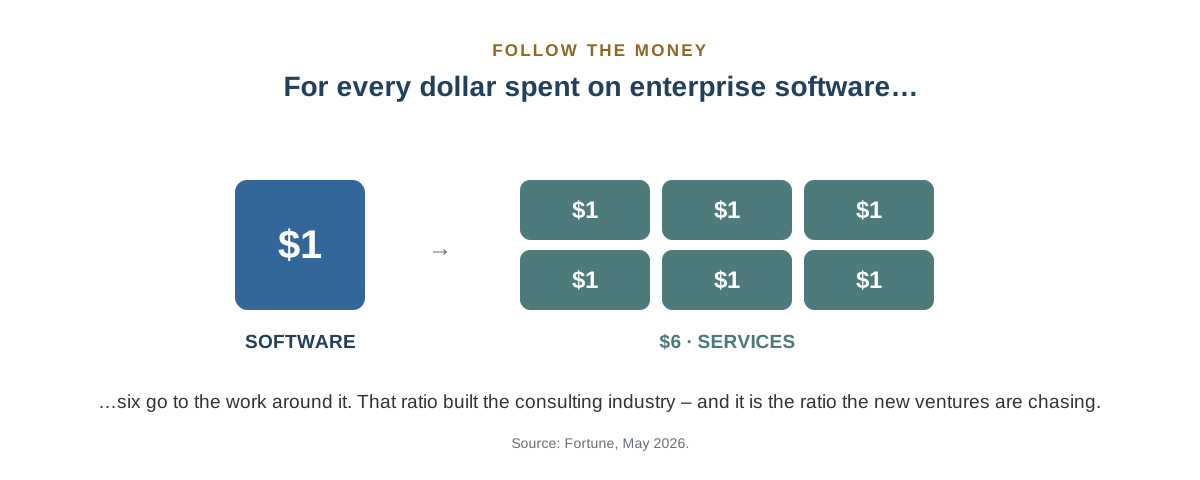
This is, in a strange way, the most honest signal the AI industry has produced. For three years the pitch has been that the technology is the value. Last week, $11.5 billion of smart money said the value is in the work around the technology: deciding where it belongs, redesigning the processes it touches, governing what it’s allowed to do, and staying long enough to prove the returns showed up.
That has been our position all along.
Three questions before you buy
If I were buying enterprise AI right now, the announcements would sharpen three questions about who I let help me.
Do you want your services partner to be an arm of your AI vendor? The new ventures are impressive, and the engineering talent will be real. But a services firm inside an AI company wins when you consume more of that company’s technology. Every recommendation arrives with that gravity attached. Independent advice and vendor advice are different products, even when they look identical in a proposal.
Do you want a consulting partner that was born yesterday? AI has spawned hundreds of new boutiques, many founded within the last eighteen months. Some are brilliant. But the work that determines whether AI produces value – governance, decision rights, process redesign, adoption, measurement – is not new work, and it rewards firms that have done it across many technology cycles, in messy organizations, under real constraints.
Or do you want a firm that was selling shovels before this gold rush? The disciplines that make AI pay are the same disciplines that made cloud pay, that made CRM pay, that made every wave before them pay. Firms that built those muscles over decades didn’t need AI to justify their existence. They need it to be one more technology that only creates value when the organization around it changes.
What the work actually looks like
None of this is an argument against the technology. The technology is a seismic shift. It is an argument about sequence. The organizations getting real returns are not the ones with the best model access – everyone has the best model access. They are the ones treating AI as an operational change program: clear standards for what gets built and bought, governance that can say no, processes redesigned around the tool rather than the tool bolted onto the process, and honest measurement of value actually realized – not value projected in the business case.
That work is unglamorous. It doesn’t demo well. And it is precisely where $11.5 billion just went.
The takeaway
AI is becoming a commodity. Change is hard. Governance is hard. Process improvement is hard. That’s where the money is going, because that’s where the value is captured or lost. And that work doesn’t need a new consulting industry – there are enough of us. It needs people who have been selling shovels since before the latest gold rush.
If you’re sorting out where AI genuinely belongs in your operation – and who should help you get it there – we’d welcome the conversation.
Voyage Advisory helps organizations turn AI investment into realized value through disciplined governance, process redesign, and hands-on delivery. Learn more at voyageadvisory.com.
Notes
- “Anthropic Partners with Blackstone, Hellman & Friedman, and Goldman Sachs to Launch Enterprise AI Services Firm,” Blackstone press release, May 4, 2026, https://www.blackstone.com/news/press/anthropic-partners-with-blackstone-hellman-friedman-and-goldman-sachs-to-launch-enterprise-ai-services-firm/; Hayden Field, “Anthropic Teams with Goldman, Blackstone and Others on $1.5 Billion AI Venture,” CNBC, May 4, 2026.
- “Anthropic and OpenAI Are Both Launching Joint Ventures for Enterprise AI Services,” TechCrunch, May 4, 2026, https://techcrunch.com/2026/05/04/anthropic-and-openai-are-both-launching-joint-ventures-for-enterprise-ai-services/.
- Lyndon B. Johnson, “Remarks at the University of Michigan,” May 22, 1964, Public Papers of the Presidents; National Commission on Technology, Automation, and Economic Progress, established by Public Law 88-444, August 19, 1964.
- “Anthropic Takes Shot at Consulting Industry in Joint Venture with Wall Street Giants,” Fortune, May 4, 2026, https://fortune.com/2026/05/04/anthropic-claude-consulting-industry-joint-venture-blackstone-goldman-sachs/.