

AI-driven transformation for the energy sector
Date Published
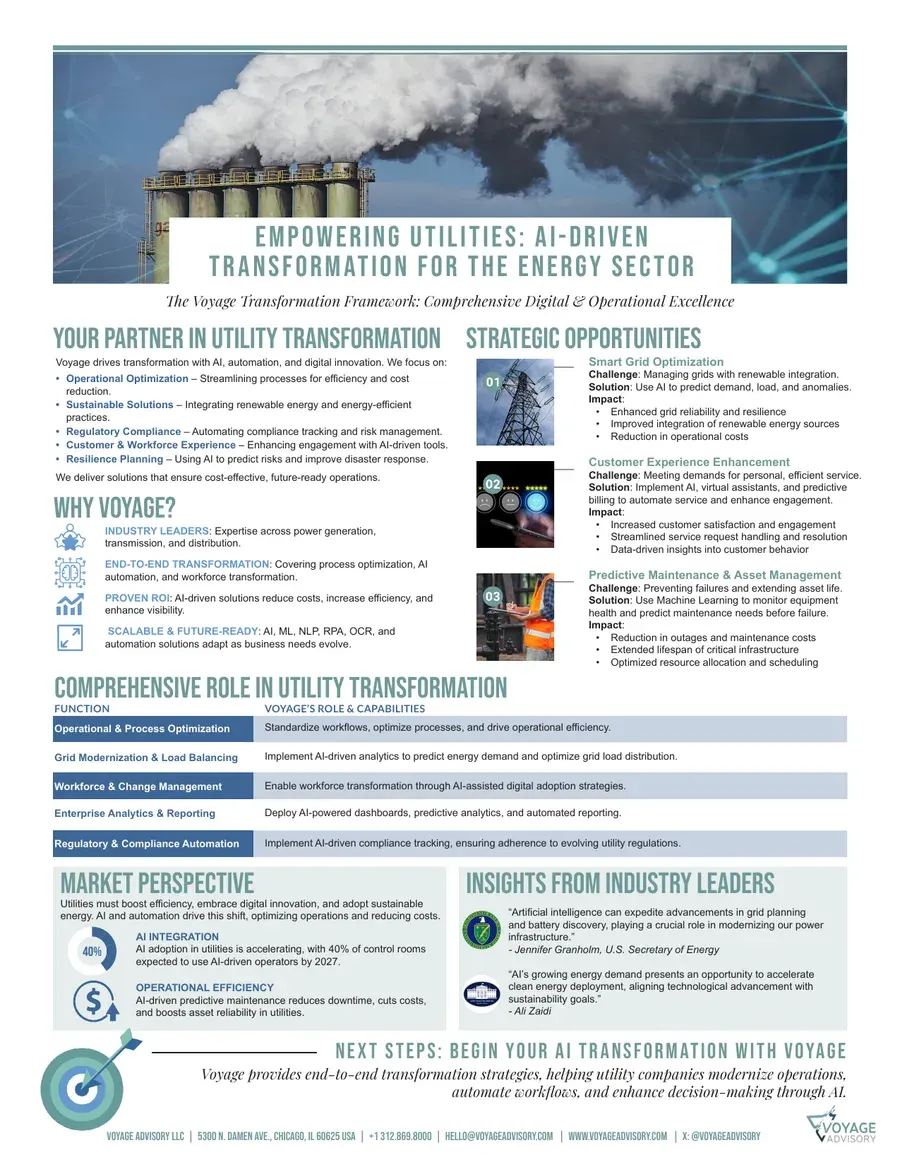
Utilities are being asked to hold reliability and safety steady while integrating renewables, absorbing regulatory change, and meeting customer expectations set by companies that are not utilities. AI is useful here, but only against a named problem.
Three places it pays
Smart grid optimization. The problem is managing a grid with renewable generation on it. AI predicts demand, load and anomalies, which improves reliability and resilience, eases renewable integration, and takes cost out of operations.
Customer experience. The problem is meeting a demand for personal, efficient service with the staffing that exists. Virtual assistants and predictive billing automate the routine and lift engagement, and the interaction data becomes an input rather than exhaust.
Predictive maintenance and asset management. The problem is failure and asset life. Machine learning monitors equipment health and predicts maintenance before failure, reducing outages and extending the life of critical infrastructure.
Where Voyage sits
Operational and process optimization. Standardize workflows, optimize processes, drive efficiency.
Grid modernization and load balancing. AI-driven analytics that predict demand and optimize distribution.
Workforce and change management. Digital adoption strategies that make the transformation stick.
Enterprise analytics and reporting. Dashboards, predictive analytics, automated reporting.
Regulatory and compliance automation. Compliance tracking against rules that keep changing.
The market context
AI adoption in utilities was accelerating when this was written in early 2025, with 40 percent of control rooms expected to use AI-driven operators by 2027. Predictive maintenance was already the clearest case: less downtime, lower cost, better asset reliability.