
Workforce onboarding at scale
Date Published
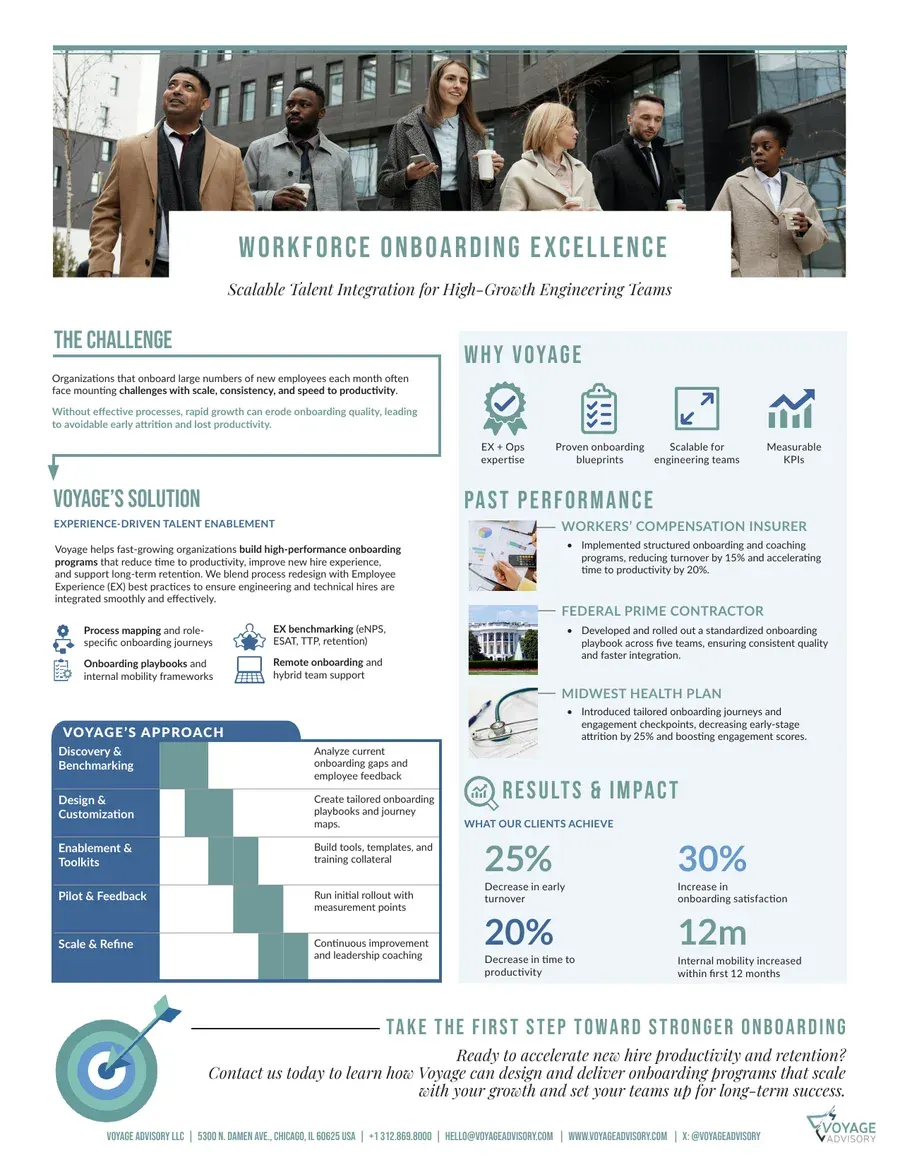
Organizations bringing on large numbers of people every month hit the same wall on scale, consistency and speed to productivity. Without a process that holds, growth erodes onboarding quality, and the cost arrives later as avoidable early attrition and lost output.
What the work covers
Process mapping and role-specific onboarding journeys, so a technical hire and a support hire are not run through the same week.
Onboarding playbooks and internal mobility frameworks.
Employee experience benchmarking against eNPS, employee satisfaction, time to productivity and retention.
Remote onboarding and hybrid team support, which is where most existing programs were never designed to work.
The six steps
Discovery and benchmarking. Analyze the current gaps and what employees already say about them.
Design and customization. Build tailored playbooks and journey maps.
Enablement and toolkits. Produce the tools, templates and training collateral.
Pilot and feedback. Run an initial rollout with measurement points built in.
Scale and refine. Continuous improvement, with leadership coaching alongside it.
Past performance
A workers compensation insurer. Structured onboarding and coaching cut turnover by 15 percent and accelerated time to productivity by 20 percent.
A federal prime contractor. A standardized onboarding playbook rolled out across five teams, giving consistent quality and faster integration.
A midwest health plan. Tailored onboarding journeys with engagement checkpoints cut early-stage attrition by 25 percent and lifted engagement scores.
What clients achieve
Decrease in early turnover: 25%
Increase in onboarding satisfaction: 30%
Decrease in time to productivity: 20%
Internal mobility within the first 12 months: increased