
PMO excellence: standing one up, or fixing the one you have
Date Published
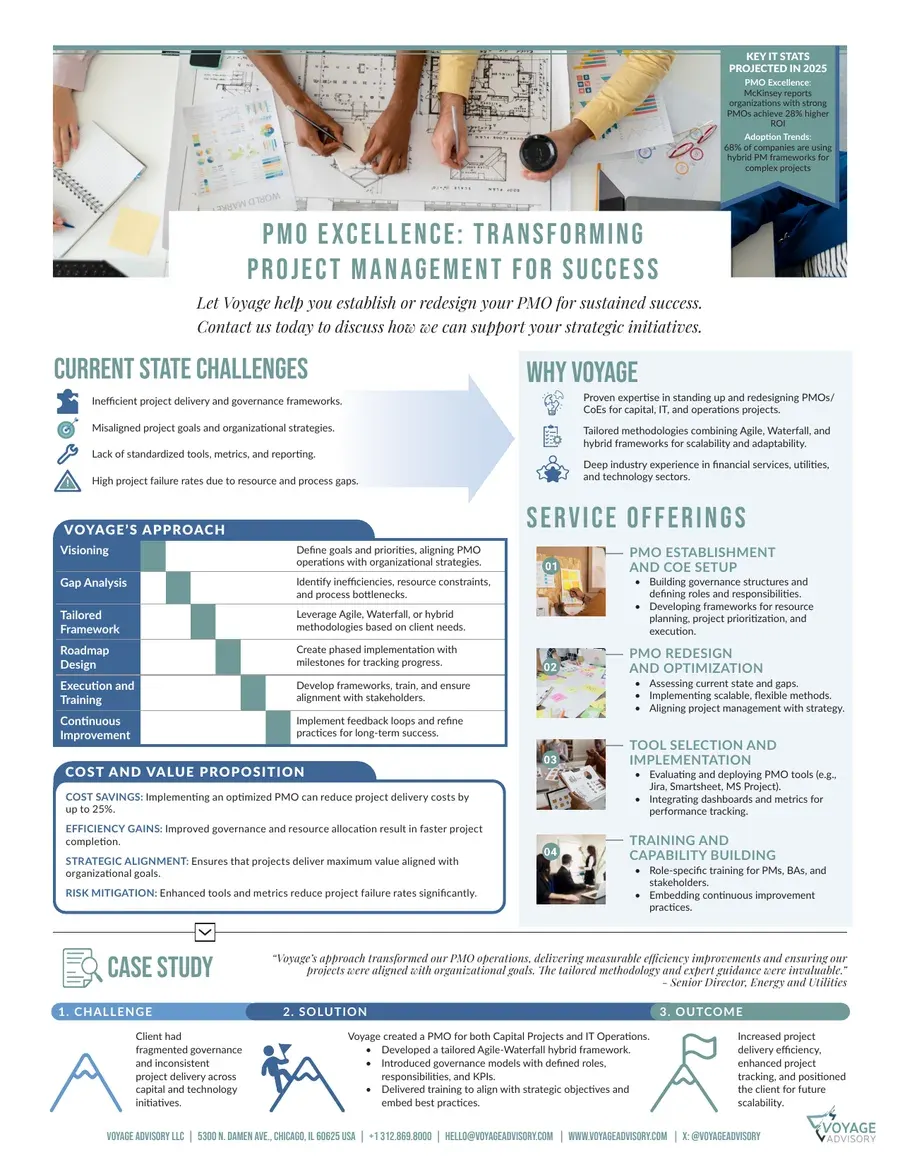
The symptoms are consistent: inefficient delivery and governance, project goals that do not line up with organizational strategy, no standard tools, metrics or reporting, and a failure rate driven by resource and process gaps rather than by ambition.
The approach
Visioning. Define goals and priorities, and align what the PMO does to what the organization is trying to achieve.
Gap analysis. Identify the inefficiencies, resource constraints and process bottlenecks that are actually operating.
Tailored framework. Agile, waterfall or hybrid, chosen against the need rather than the preference.
Roadmap design. A phased implementation with milestones that can be tracked.
Execution and training. Build the frameworks, train the people, and align the stakeholders.
Continuous improvement. Feedback loops that refine the practice rather than freeze it.
What gets delivered
PMO and center of excellence setup. Governance structures, defined roles and responsibilities, and frameworks for resource planning, prioritization and execution.
PMO redesign and optimization. Current state and gap assessment, scalable methods, and project management aligned to strategy.
Tool selection and implementation. Evaluating and deploying tools such as Jira, Smartsheet and MS Project, with dashboards and metrics wired in.
Training and capability building. Role-specific training for project managers, business analysts and stakeholders, with continuous improvement embedded.
The case for it
An optimized PMO can reduce project delivery costs by up to 25 percent. McKinsey reports that organizations with strong PMOs achieve 28 percent higher return, and 68 percent of companies now use hybrid project management frameworks for complex work.
One client had fragmented governance and inconsistent delivery across capital and technology initiatives. Voyage built a PMO covering both capital projects and IT operations, on a tailored agile-waterfall hybrid, with governance models carrying defined roles, responsibilities and indicators, and training to embed them. Delivery efficiency and project tracking both improved, and the organization was left able to scale.