

Warehouse relocation support
Date Published
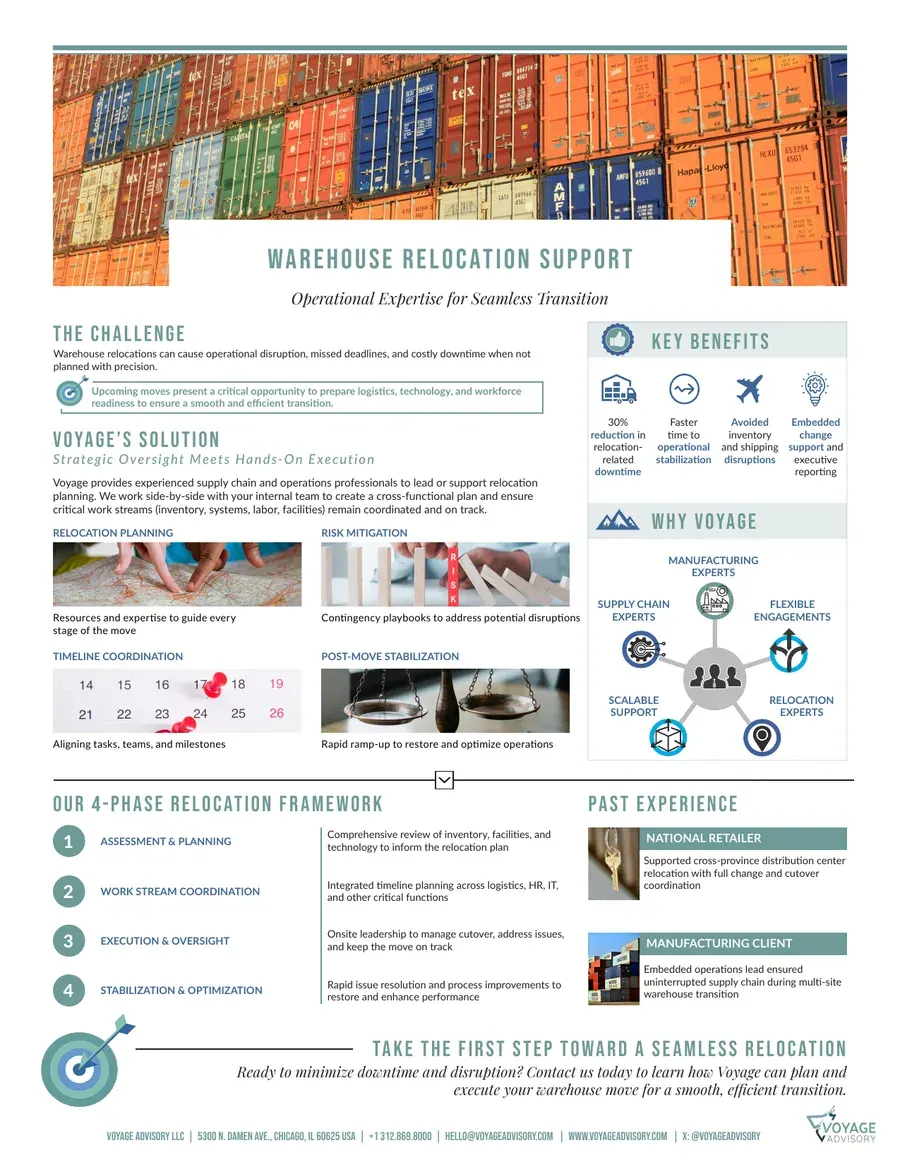
Warehouse relocations cause operational disruption, missed deadlines and expensive downtime when they are not planned precisely. A move is also the one moment when logistics, technology and workforce readiness are all open at once, which makes it an opportunity as well as a risk.
The four phases
Assessment and planning. A full review of inventory, facilities and technology, which is what the relocation plan is then built from.
Workstream coordination. Integrated timeline planning across logistics, HR, IT and the other functions that will otherwise each plan separately.
Execution and oversight. Onsite leadership through the cutover, managing issues as they arrive rather than reporting them afterwards.
Stabilization and optimization. Rapid issue resolution and process improvement to restore performance and then improve on it.
What it protects
Change support and executive reporting are embedded rather than added, because a move that the floor has not been prepared for stabilizes slowly regardless of how well the logistics ran.
Reduction in relocation-related downtime: 30%
Time to operational stabilization: faster
Inventory and shipping disruption: avoided
Past experience
A national retailer, supported through a cross-province distribution center relocation with full change and cutover coordination.
A manufacturing client, where an embedded operations lead kept the supply chain uninterrupted through a multi-site warehouse transition.